
GRPO (Group Relative Policy Optimization )
https://arxiv.org/pdf/2402.03300
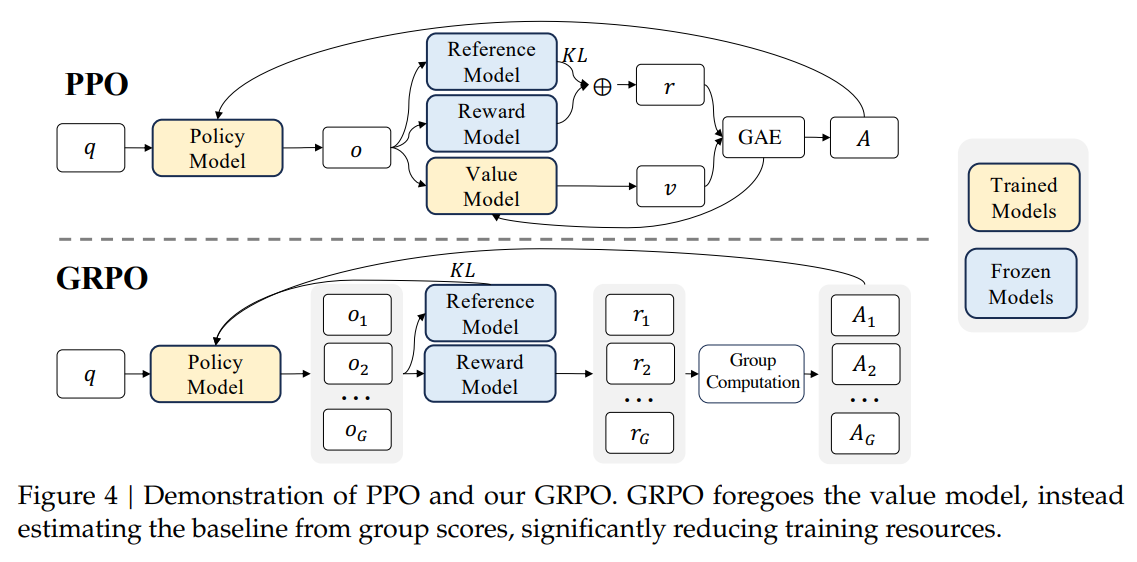
对于每个question q,GRPO从old policy (pi_{old}) 采样一组输出 ({o_1, o_2 ...,o_G})
优化下面的objective以获得新的policy
[D_{KL} left [ pi_{theta}||pi_{ref} right] =
frac{pi_{ref}(o_{i,t} | q,o_{i, 其中,(epsilon)和(beta)为超参数,(hat{A}_{i,t})是advantage。 采用reward modle对这些输出进行打分,生成对应的G的reward (r = {r_1, r_2, ..., r_G}) 对r进行标准化,得到对于每个输出(o_i)结束后的reward标准化advantage (hat{A}_{i,t}),并根据上面objective对policy进行优化 [hat{A}_{i,t} = tilde{r_i}=frac{r_i-mean(r)}{std(r)}
] 概括:根据old policy得到一组输出,计算输出的advantage,据此计算新的policy所需要的优化方向,也就是policy gradient。 所谓policy的old与new,即固定下的策略和正在更新的策略。通过对old policy进行采样,可以进行多步探索,但又通过clip使得更新幅度不过大,保证了数值的稳定性。计算同一组数据在新policy下的概率,得到新policy下的loss,更新新的policy让其相比旧policy能够提升objective。 https://github.com/huggingface/open-r1/issues/239#issuecomment-2646297851 观察objective,对于某prompt 如果假设每次迭代仅执行一步探索,此时也就是(pi_{theta_{old}} = pi_{theta}),用同一个policy进行采样,计算advantage并且更新这个policy 则objective [J_{text{GRPO}}(theta) = frac{1}{G} sum_{i=1}^{G} frac{1}{|o_i|} sum_{t=1}^{|o_i|} Bigg[ min left( frac{pi_{theta}(o_{i,t} mid q, o_i, Advantage (A) 不依赖于某个具体token (t), [frac{1}{|o_i|} sum_{t=1}^{|o_i|} hat{A}_{i,t} = frac{1}{|o_i|} sum_{t=1}^{|o_i|} hat{A}_i = hat{A}_i
] 此外,(hat{A}_t) 由标准化可知 [frac{1}{G} sum_{i=1}^{G} frac{1}{|o_i|} sum_{t=1}^{|o_i|} hat{A}_{t} = 0
] 因此 [J_{text{GRPO}}(theta) = - frac{1}{G} sum_{i=1}^{G} beta D_{text{KL}}[pi_{theta} parallel pi_{text{ref}}]
] 实际训练loss与KL有关。 https://arxiv.org/pdf/2402.03300 同样进行一步探索,假设(pi_{theta_{text{old}}} = pi_{theta}) [J_{text{GRPO}}(theta) = mathbb{E} big[q sim p_{text{sft}}(Q), {o_i}_{i=1}^{G} sim pi_{theta_{text{old}}}(O|q) big]
\
frac{1}{G} sum_{i=1}^{G} frac{1}{|o_i|} sum_{t=1}^{|o_i|} left[
frac{pi_{theta}(o_{i,t} | q, o_{i, 求梯度,对于中间部分 [nabla_{theta} [frac{pi_theta}{pi_{theta_{old}}}A-beta(frac{pi_{ref}}{pi_theta}-log frac{pi_{ref}}{pi_theta} -1)]
\
= nabla_{theta} [frac{pi_theta}{pi_{theta_{old}}}A-beta(frac{pi_{ref}}{pi_theta}+log pi_theta)]
\
= frac{nabla_{theta}pi_theta}{pi_{theta_{old}}}A - beta (-frac{pi_{ref}}{pi_theta}frac{nabla_{theta}pi_theta}{pi_theta} + frac{nabla_{theta}pi_theta}{pi_theta})
\
= frac{nabla_{theta}pi_theta}{pi_theta}(A+beta(frac{pi_{ref}}{pi_theta}-1))
\
=(A+beta(frac{pi_{ref}}{pi_theta}-1))nabla_{theta}log pi_theta
] 得到 [nabla_{theta} J_{text{GRPO}}(theta) = mathbb{E} big[q sim p_{text{sft}}(Q), {o_i}_{i=1}^{G} sim pi_{theta_{text{old}}}(O|q) big]
\
frac{1}{G} sum_{i=1}^{G} frac{1}{|o_i|} sum_{t=1}^{|o_i|} left[
hat{A}_{i,t} + beta left( frac{pi_{text{ref}}(o_{i,t} | q, o_{i, 其中,(nabla_{theta} log pi_{theta}(o_{i,t} | q, o_{i, [GC_{GRPO}(q,o,t,pi_{theta_{rm}}) = hat{A}_{i,t} + beta left( frac{pi_{text{ref}}(o_{i,t} | q, o_{i, https://github.com/huggingface/trl https://github.com/huggingface/trl/blob/main/trl/trainer/grpo_trainer.py trl中关于gpro的实现 方法来自一步探索, 有(pi_{theta_{text{old}}} = pi_{theta}) [J_{text{GRPO}}(theta) = frac{1}{G} sum_{i=1}^{G} frac{1}{|o_i|} sum_{t=1}^{|o_i|} Bigg[ min left( frac{pi_{theta}(o_{i,t} mid q, o_i, 将objective转成loss 代码中
Loss
梯度
实现
def compute_loss(self, model, inputs, return_outputs=False, num_items_in_batch=None):

	...

    # Compute the KL divergence between the model and the reference model
    ref_per_token_logps = inputs["ref_per_token_logps"]
    per_token_kl = torch.exp(ref_per_token_logps - per_token_logps) - (ref_per_token_logps - per_token_logps) - 1

    # x - x.detach() allows for preserving gradients from x
    advantages = inputs["advantages"]
    per_token_loss = torch.exp(per_token_logps - per_token_logps.detach()) * advantages.unsqueeze(1)
    per_token_loss = -(per_token_loss - self.beta * per_token_kl)
    loss = ((per_token_loss * completion_mask).sum(dim=1) / completion_mask.sum(dim=1)).mean()

    ...

    return loss
per_token_loss = torch.exp(per_token_logps - per_token_logps.detach()) * advantages.unsqueeze(1)
torch.exp(per_token_logps - per_token_logps.detach())的值恒为1,对应$ frac{pi_theta}{pi_{theta_{old}}}$,保留以便梯度传播。
 登录查看全部
参与评论
手机查看
返回顶部